What Helps, What Doesn’t, and How to Use It Safely
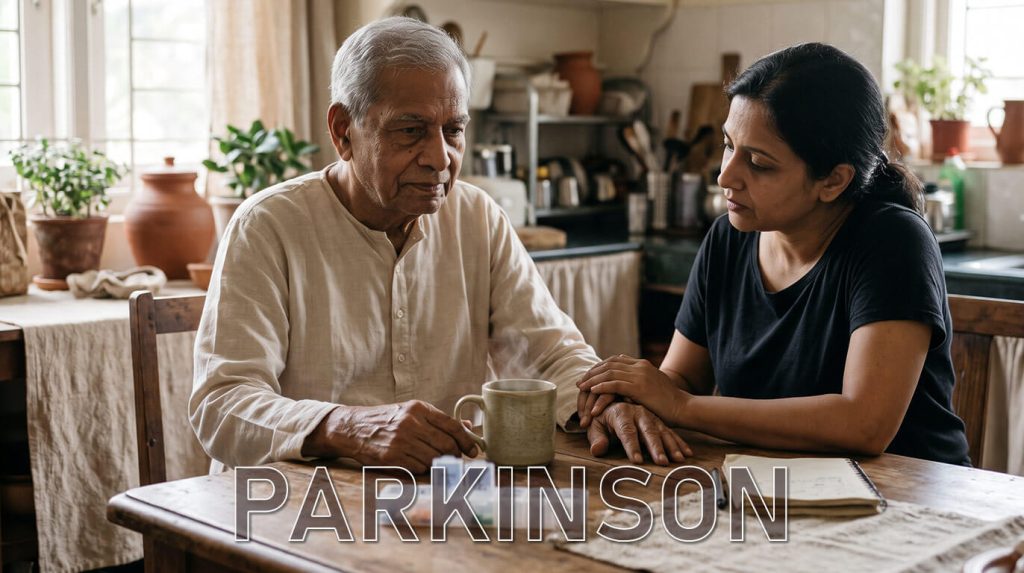
You awaken with a slight tremor in your hand as you reach for your morning tea. Every movement feels a little stiffer-your muscles tight as if weighed down by night. Tying shoes, turning in bed, buttoning a shirt… each task demands extra concentration. If you have Parkinson’s disease, you know these struggles intimately. The tremor in your hand or the challenge of stepping out of a chair can be frustrating, even scary. You and millions of others have heard of Kampavata, the Ayurvedic name for this condition. You may be wondering: can ancient Ayurvedic wisdom ease these daily challenges?
This guide approaches Parkinson’s disease with empathy and caution. We’ll blend the latest medical insights (dopamine loss in the brain’s movement center) with Ayurvedic concepts (Vata imbalance in nerve tissues) in plain language. You’ll find practical steps-exercise, diet, herbs, routines-that may relieve symptoms and support function, always emphasizing safety and that modern medication should never be stopped without a doctor’s advice.
Read my blog on Ayurveda for Migraine Treatment and Relief
How Parkinson’s Works: The Neurologist’s View and the Ayurvedic View
What happens in the brain
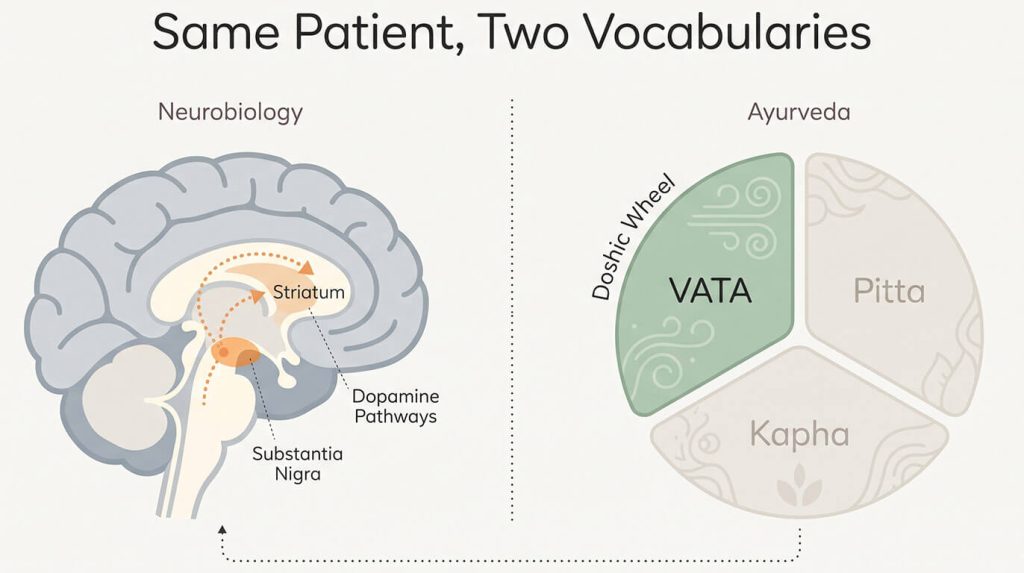
Parkinson’s disease develops when dopamine-producing neurons in a small brainstem region called the substantia nigra die off gradually. Dopamine acts like a smooth-running conductor for movement. When the supply falls, the orchestra loses its timing, and you see tremor at rest, stiffness, slowness (bradykinesia) and balance problems.
By the time a person notices a tremor, a large share of those neurons has already disappeared. Misfolded alpha-synuclein protein accumulates inside cells, inflammation and oxidative stress add further damage, and the gut often shows trouble years earlier. Constipation, loss of smell and acting out dreams during sleep can all precede the motor signs.
So far, no treatment, Ayurvedic or conventional, has been proven to stop or reverse this loss. Medicines such as levodopa replace dopamine and relieve symptoms. They do not rebuild the neurons.
What Ayurveda calls it: Kampavata
Ayurvedic physicians describe the condition as Kampavata: kampa means tremor, and vata is the dosha governing movement, nerve signaling and the nervous system’s “wind-like” quality. Later classical texts such as the Basavarajiyam outline the picture of tremor, rigidity, slowed movement and disturbed sleep. In this framework, aggravated Vata depletes majja dhatu, the tissue Ayurveda links with nerves and marrow.
In Plain-English, Ayurveda sees a nervous system that has become dry, depleted and overactive in the wrong places, and it tries to nourish, calm and lubricate it.
Where the two views meet
The two systems describe the same patient with different vocabularies. Some overlaps seem genuine. Ayurveda emphasizes digestion and bowel health, and modern research now links gut function to Parkinson’s. Ayurveda prescribes routine and rest, and neurologists now know that sleep and consistent daily rhythm affect symptoms. Ayurveda recommends movement and breathing practices, and exercise has solid evidence in Parkinson’s.
Other claims have no modern equivalent. Nobody has measured Vata in a blood test, and no scan shows majja dhatu. Treat these terms as a traditional way of organizing care, not as laboratory facts.
| Question | Conventional Neurology | Ayurveda (Kampavata) |
| What goes wrong? | Loss of dopamine neurons; alpha-synuclein buildup | Vata aggravation with tissue (majja dhatu) depletion |
| Main goal | Control motor and non-motor symptoms, preserve function | Pacify Vata, nourish nerve tissue, restore digestion |
| Core tools | Levodopa, dopamine agonists, MAO-B inhibitors, DBS surgery, exercise | Herbs (Mucuna), oil therapies, Panchakarma, diet, yoga |
| Strength | Strong trial data, reliable symptom control | Whole-person, routine-based, supportive care |
| Weakness | Side effects, no disease-modifying cure | Limited trials, variable product quality |
Evidence-Backed Therapies, Botanicals and Lifestyle Solutions
Sorted each option into three buckets: symptom relief, functional management and structural change. No Ayurvedic therapy has shown structural change, meaning that none has been proven to regrow neurons or halt the disease.
Mucuna pruriens (kapikacchu): the one herb with real clinical data
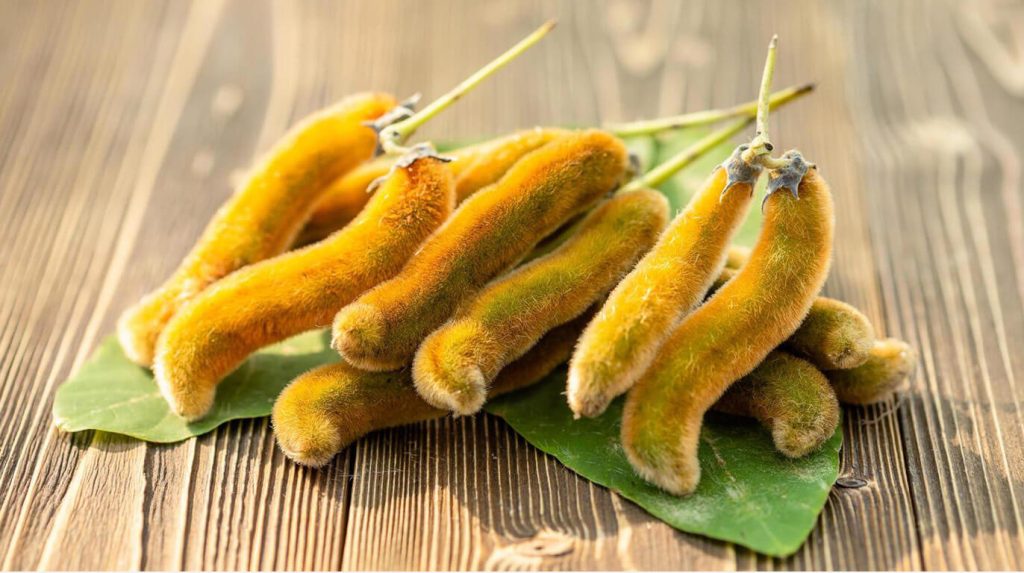
Velvet bean seeds contain roughly 4 to 6 percent levodopa, the same molecule found in standard Parkinson’s drugs. That fact explains why Mucuna works pharmacologically when it works at all. It also explains its risks.
What the research shows:
- A double-blind crossover study found that high-dose Mucuna produced clinical effects similar to levodopa alone at the same dose, with a more favorable tolerability profile.
- A 16-week pilot in advanced Parkinson’s reported variable results, and side effects limited the benefit for some patients.
- A systematic review of five clinical trials with 108 participants found shorter time to “on” state, longer “on” duration and few adverse events.
- An open-label trial followed 32 untreated patients for 12 months and reported that Mucuna powder was non-inferior to standard levodopa with a decarboxylase inhibitor. The trial was small and clear, but it matters most for regions where levodopa is hard to obtain.
The honest reading: Mucuna is a crude levodopa source with some promising small trials. It is not a gentler alternative to levodopa and not a cure. Commercial capsules vary widely in actual levodopa content, so two bottles with the same label can act very differently.
Other Ayurvedic herbs
Ashwagandha (Withania somnifera), brahmi (Bacopa monnieri) and guduchi appear in many Kampavata formulas. Most supportive data comes from lab and animal studies showing antioxidant or neuroprotective effects. Human trials in Parkinson’s remain limited. Treat these as traditional, plausible, untested.
Oil therapies and Panchakarma
Abhyanga (warm oil massage), Shirodhara (a steady stream of warm oil over the forehead) and Basti (medicated enema) form the backbone of Ayurvedic clinic care. Many people with Parkinson’s report less stiffness, better sleep and a calmer mood. The research consists mostly of small, uncontrolled studies, so claims of nerve repair go beyond the evidence. Think of these as comfort and relaxation therapies with possible symptom benefit.
Read my blog on Importance of regular massage for simple and scientific secret of healthy Longevity
Yoga, breathing and movement
Here Ayurveda and modern medicine agree. Exercise, tai chi, dance and yoga improve balance, flexibility, gait and quality of life in Parkinson’s. Trials show modest but real gains. Of everything in this article, regular movement carries the best evidence.
Reference table: therapies at a glance
| Option | Ancient use | Best described as | Key cautions |
| Mucuna pruriens | Vata-calming nervine | Symptom relief | Contains levodopa; interacts with Parkinson’s drugs; irregular dose |
| Ashwagandha, Brahmi | Rasayana (reviving) tonics | Unproven | Can interact with sedatives, thyroid drugs |
| Abhyanga / Shirodhara | Vata reunion | Comfort, relaxation | Fall risk on oily floors; skin allergy |
| Basti (medicated enema) | Primary Vata therapy | Unproven; may ease constipation | Dehydration; avoid if frail or on blood thinners without advice |
| Yoga and pranayama | Daily discipline | Functional management | Balance supervision needed |
| Fiber-rich, warm, cooked diet | Digestive fire support | Symptom relief for gut issues | Protein timing with levodopa |
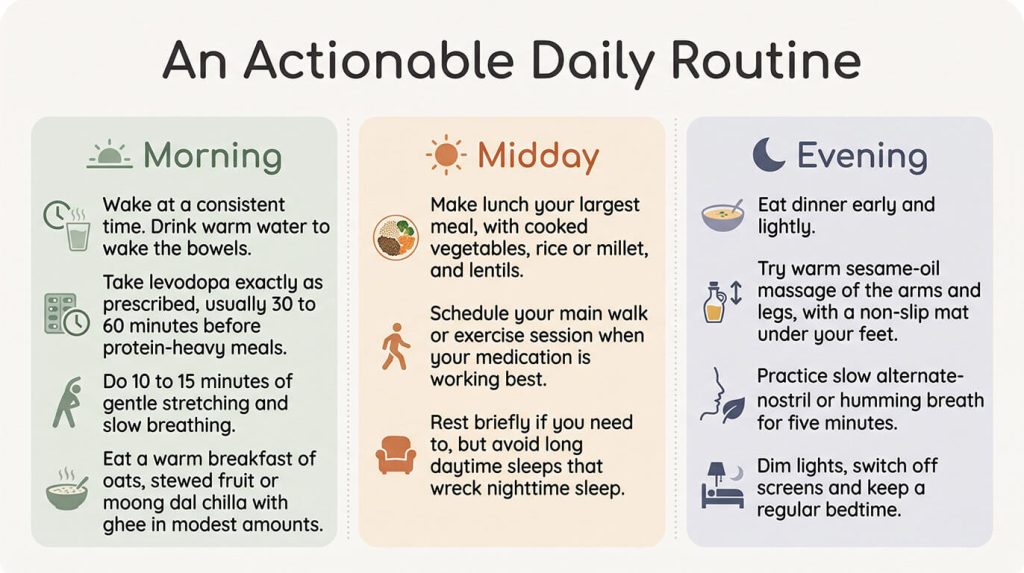
An Actionable Daily Routine
Ayurveda loves routine, and so does the Parkinson’s brain. The following schedule blends both traditions. Adjust it with your care team.
Morning
- Wake at a consistent time. Drink warm water to wake the bowels.
- Take levodopa exactly as prescribed, usually 30 to 60 minutes before protein-heavy meals.
- Do 10 to 15 minutes of gentle stretching and slow breathing.
- Eat a warm breakfast of oats, stewed fruit or moong dal chilla with ghee in modest amounts.
Midday
- Make lunch your largest meal, with cooked vegetables, rice or millet, and lentils.
- Schedule your main walk or exercise session when your medication is working best.
- Rest briefly if you need to, but avoid long daytime sleeps that wreck nighttime sleep.
Evening
- Eat dinner early and lightly.
- Try warm sesame-oil massage of the arms and legs, with a non-slip mat under your feet.
- Practice slow alternate-nostril or humming breath for five minutes.
- Dim lights, switch off screens and keep a regular bedtime.
Protein and levodopa: Dietary protein competes with levodopa for absorption in the gut and for entry into the brain. If you notice more “off” time after meals, ask your neurologist or a dietitian about shifting protein toward dinner. Do not cut protein on your own, because muscle loss makes Parkinson’s worse.
Read my blog on How to create an Ayurvedic routine for your lifestyle
When to Seek Urgent Clinical Care
Contact your neurologist or emergency services immediately if you notice any of the following:
- Sudden confusion, hallucinations or paranoia, especially after starting a new herb or raising a dose
- Fainting, severe dizziness on standing, or a rapid, pounding heartbeat
- Fever with severe muscle rigidity after missing or stopping levodopa doses (a medical emergency)
- Repeated falls, choking while eating, or new trouble swallowing
- Severe headache or very high blood pressure while taking a Monoamine oxidase (MOA) inhibitor with any herbal product
- Uncontrolled writhing movements (dyskinesia) that appear suddenly
Interaction alert: Mucuna contains levodopa. Taking it along with prescription levodopa can double up the dose and cause nausea, low blood pressure, dyskinesia and psychosis. Avoid it with non-selective MAO inhibitors, and use only under medical supervision if you take selegiline or rasagiline. Antipsychotic drugs can blunt its effect. People with a history of psychosis, melanoma, narrow-angle glaucoma, serious heart rhythm problems or active ulcers should avoid it, as should pregnant women.
Product quality alert: Studies of Ayurvedic products sold online found that some contained detectable lead, mercury or arsenic. Buy only from manufacturers who publish third-party heavy-metal testing.
Frequently Asked Questions for Ayurvedic treatment on Parkinson’s diseases
No. Nothing, in Ayurveda or modern medicine, has been proven to cure it. Ayurvedic care may ease some symptoms, such as stiffness, constipation, stress and poor sleep.
Only with your neurologist's knowledge. Both supply levodopa, so the combined dose can run higher than you intend. Capsule strength varies by brand and batch. If your neurologist agrees to a trial, expect careful monitoring of your motor diary, blood pressure and mood.
No. Stopping levodopa abruptly can trigger a dangerous rigidity-and-fever reaction. Even if you want to reduce drugs for side effects, your neurologist should adjust the schedule slowly.
Look for a practitioner with a recognized degree (such as BAMS in India) who is willing to coordinate with your neurologist, asks for your medication list and explains each ingredient.
No human trial has shown that any Ayurvedic herb slows progression. Exercise currently offers the most encouraging indirect evidence, since fitter patients tend to keep function longer. Whether exercise changes the underlying disease course remains under study.
An Integrative 7-Step Action Plan
- Get the diagnosis confirmed. See a movement-disorder specialist or neurologist. Other conditions mimic Parkinson’s, and treatments differ.
- Start (or keep) proven treatment. Take prescribed medication on time and discuss device or surgical options such as deep brain stimulation when the time comes.
- Build a movement habit first. Aim for most days of the week, mixing aerobic activity, balance work and flexibility. Physiotherapy referrals help.
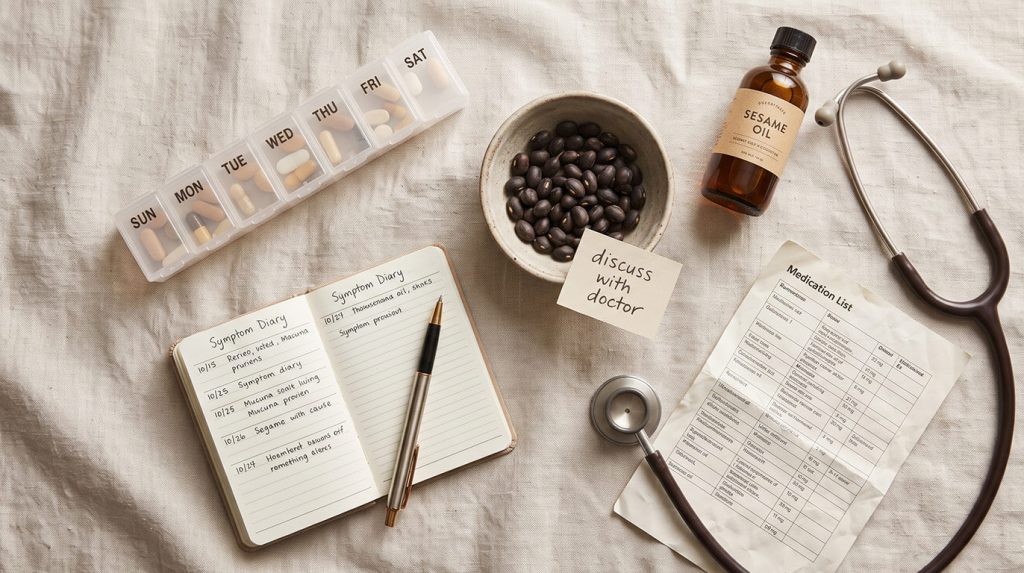
- Bring a list to your appointment. Write down every herb, powder and oil you take or want to try, with brand names and doses.
- Choose one change at a time. Add a single Ayurvedic element, such as oil massage or yoga, then watch for two to four weeks. This makes cause and effect easier to spot.
- Track symptoms. Use a simple diary of “on” and “off” times, sleep, bowel movements and mood. Share it at each visit.
- Review and adjust every three months. Keep what clearly helps, drop what doesn’t, and keep both clinicians informed.
Myth vs. Reality
| Myth | Reality |
| “Natural means safe.” | Mucuna carries real drug effects and interactions. Contaminated herbal products have caused heavy-metal poisoning. |
| “Ayurveda can cure Parkinson’s.” | No evidence shows a cure from any system of medicine. |
| “Mucuna replaces levodopa safely.” | Small trials show promise, but dose variability and side effects keep it from replacing prescribed treatment for most patients. |
| “Panchakarma repairs nerve damage.” | It may relax and comfort. No study shows it regrows neurons. |
| “Stopping medicine detoxes the body.” | Abrupt withdrawal can cause a medical emergency. |
| “Exercise is just a bonus.” | Exercise ranks among the best-supported supportive therapies for Parkinson’s. |
Medical & Regulatory Disclaimer
This article is for general education and does not replace advice from a qualified physician. It does not diagnose, treat or prevent any disease. Parkinson’s disease requires personalized care from a neurologist or movement-disorder specialist. Do not start, change or stop any medicine, herb or supplement without discussing it with your treating doctor. Herbal and Ayurvedic products are regulated differently from prescription drugs, and their quality, potency and safety can vary. Statements about traditional use describe historical practice and are not claims of clinical proof. Research findings cited here reflect studies available at the time of writing and may change as new evidence emerges.
Do not use the information here to self-diagnose or self-treat. Parkinson’s is a complex disease: sudden changes in medicine or diet can have serious consequences. If in doubt, rely on a licensed healthcare professional for personalized management.