Overview of Ayurvedic Holistic Remedies & Herbs to Rheumatoid Arthritis (Amavata)
Rheumatoid Arthritis (RA) is a chronic autoimmune disease-causing progressive inflammation and joint destruction. It affects about 0.8% of people worldwide (with women impacted roughly three times more than men). In conventional care, treatment follows a sequence of analgesics/NSAIDs, glucocorticoids, Disease-Modifying Antirheumatic Drugs (DMARDs), biologics, and immunosuppressants. Although effective, these can have vital side effects (e.g., gastrointestinal, renal, or liver toxicity; immune suppression). Ayurvedic medicine offers a long-standing holistic alternative or complementary approach to RA (known in Ayurveda as Amavata), focusing on restoring digestion, detoxification and balancing doshas.
In Ayurveda, Amavata is characterized by accumulation of Ama (toxic metabolic debris from poor digestion) and aggravation of Vata dosha. The vitiated Vata drags Ama into the joints (sandhi), causing pain, stiffness and swelling. The Ayurvedic regimen therefore aims to eliminate Ama and pacify Vata. This involves staged therapies: Langhana (lightening diet or fasting), Deepana-Pachana (digestive herbs and bitter-pungent tonics), followed by Shodhana (detoxification) such as Virechana (therapeutic purgation) and Basti (medicated enemas). Swedana (therapeutic sweating/fomentation) and occasional oil massage may also be used to relieve stiffness. Classical texts emphasize that these steps – in this order – help “digest Ama, unblock channels and restore balance”.
Ayurvedic Understanding of Amavata
According to Ayurveda, Amavata typically begins as impaired digestion (Agni Mandya), producing sticky Ama in the gut. This Ama circulates in undigested form, clogging body channels and depriving tissues of nourishment. When Vata dosha is also high (often due to stress, cold weather, or inactivity), Vata drives the Ama into the joints. The result is severe joint pain (Shaula), swelling (Shopha), and “scorpion-sting” (Vrishika-daansh) type sharp pains. Early signs include body ache, lethargy, poor appetite and feverish feelings, reflecting Ama’s systemic impact.
The classical description of Amavata highlights Vata-Vata (“double Vata”) or Vata-Kapha combination aggravation by Ama. Etiological factors (nidana) include incompatible or oily foods, nightshifts, excess salt or sour foods, and sedentary habits. In Sanskrit verses, Madhava Nidana states: “Due to simultaneous Vata and Ama in the three junctions (Trik, i.e., spine, sacrum, pelvis), stiffness and pain in the body occur – this is Amavata”.
Signs and symptoms: Amavata evolve through stages. Initially, agnimandya (weak digestion) leads to non-specific symptoms like anorexia (Aruchi), thirst, heaviness, sleepiness and flatulence. As Ama settles, patients develop joint swelling (shopha), redness, severe pain that feels like scorpion stings (vrishikadanshavat peeda), stiffness and limited motion. Other features include fever, body pain, and abnormal tastes or digestion issues (gas, constipation). This mirrors RA’s fading pattern of symmetric joint inflammation and systemic flu-like fatigue in modern terms.
Ayurvedic Diagnosis and Assessment
An Ayurvedic practitioner diagnoses Amavata by examining dosha imbalance and Agni. The classic “Dashavidha Pariksha” assesses digestive fire (jatharagni), tongue coating (sign of Ama), pulse (nadi, often showing vitiated Vata), and joint mobility. Laboratory tests like ESR (Erythrocyte Sedimentation Rate)/CRP (C-Reactive Protein) and rheumatoid factor are not part of Ayurveda but may be noted by integrative practitioners. A senior veteran Ayurvedic rheumatologist, notes that “Amavata is typically Vata-Kapha dominated. Patients feel better with warmth and dry therapies. Examination shows cold hands/feet, coated tongue, and a wiry pulse.” The central concept is always Agni (digestion): if digestion is weak, Ama will keep forming, perpetuating the disease cycle.
Ayurvedic Treatment Principles for Rheumatoid Arthritis
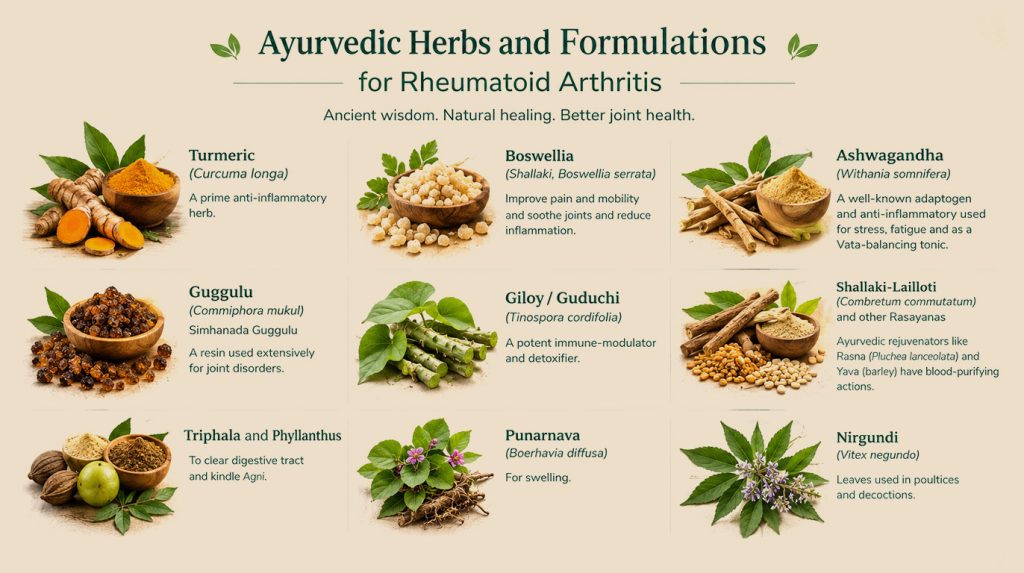
Ayurvedic treatment (Chikitsa) for Amavata follows the principle of Samprapti Vighatana (breaking the disease cycle). The classical text Chakradatta lists the sequence of therapies:
- Langhana (lightening diets): not total fasting, but a period of simple meals (typically rice gruel, barley, mung dal, herbal teas) to give the digestive system a break.
- Swedana (sudation): mild heat or steam applied to affected joints to loosen Ama and reduce stiffness. Sand poultice (Valuka Sweda) is a classical method for joints. Oil is usually avoided initially in Swedana for Amavata.
- Deepana-Pachana (digestive stimulants): Ayurvedic herbs with Tikta (bitter) and Katu (pungent) taste, such as ginger (Zingiber officinale), black pepper (Piper nigrum), neem (Azadirachta indica), or Triphala, to kindle Agni and clear Ama.
- Virechana (purgation): After Ama digestion, herbal purgatives (e.g., Haritaki, castor oil) are given to expel toxins from the gut.
- Basti (medicated enemas): Considered one of the most powerful treatments for Vata disorders. Ayurvedic decoctions or medicated oils (kashayas, ghee, or salt decoctions) are administered rectally in a series to remove Ama from the colon and balance Vata. Both Anuvasana Basti (oil enema) and Ksharavasthi (alkaline enema) are recommended specifically for Amavata.
These therapies may be customized by stage and patient strength. For example, Ghrit (herbal ghee) therapies or mild oleation (Sneha) might be introduced later if the patient’s strength allows. Throughout, the aim is to strengthen Agni so that toxins stop accumulating.
Ayurvedic Herbs and Formulations for Rheumatoid Arthritis
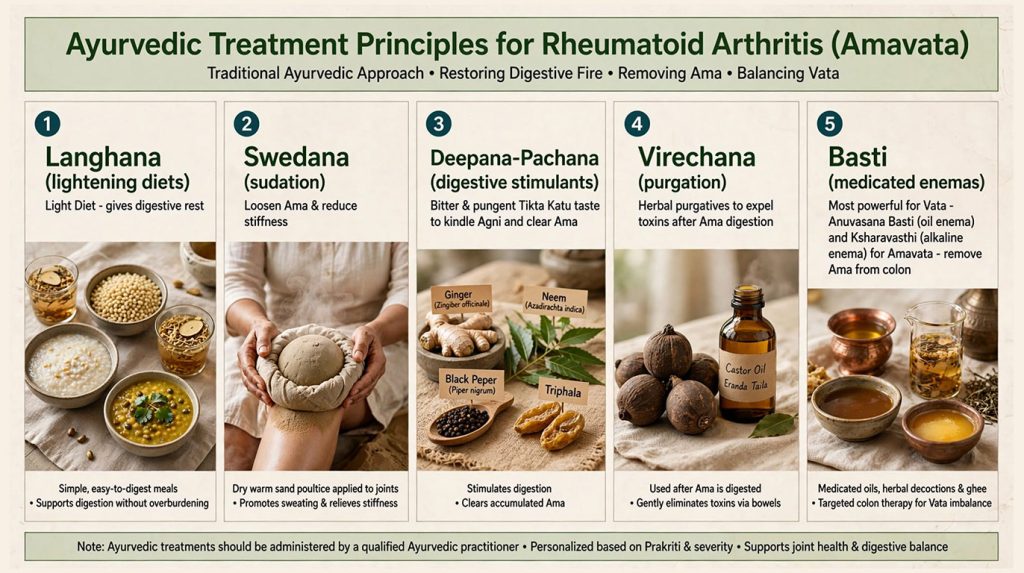
Ayurvedic practice uses many specific herbs and classical formulations to relieve Amavata symptoms and support joint health. Key examples include:
- Turmeric (Curcuma longa): A prime anti-inflammatory herb. Curcumin, its active component, has been shown in trials to reduce inflammation and joint pain in arthritis patients. Curcumin is generally safe and may improve arthritis symptoms, though evidence quality varies. It is often given with black pepper (Piperine) to enhance absorption.
- Boswellia (Shallaki, Boswellia serrata): Its gum resin contains boswellic acids that inhibit leukotrienes. Clinical studies (mainly in osteoarthritis) show Boswellia extracts improve pain and mobility. In one trial, a standardized Boswellia extract significantly reduced knee arthritis pain within 5 days. Ayurvedically, Boswellia is used to soothe joints and reduce inflammation.
- Ashwagandha (Withania somnifera): A well-known adaptogen and anti-inflammatory used for stress, fatigue and as a Vata-balancing tonic.
- Guggulu (Commiphora mukul) – Simhanada Guggulu: A resin used extensively for joint disorders. Simhanada Guggulu is a classical prescription combining guggulu with pungent herbs; it is specifically indicated in Amavata in Ayurvedic texts. Modern research shows guggulsterones can modulate inflammatory pathways, and guggulu formulations (e.g., Maha Rasnadi Gutika or Guggulu-Tiktaka Ghrita) have shown anti-inflammatory effects in animal and cell studies.
- Giloy/Guduchi (Tinospora cordifolia): A potent immune-modulator and detoxifier. Guduchi is considered Vata-Kapha balancing and Ama-destroying. Clinical trials in other conditions suggest it can lower inflammatory markers, and it is widely used in RA protocols.
- Shallaki-Lailloti (Combretum commutatum) and other Rasayanas: Ayurvedic rejuvenators like Rasna (Pluchea lanceolata) and Yava (barley) have blood-purifying actions. Modern studies show Rasna extracts downregulate Vascular Endothelial Growth Factor (VEGF) and pro-inflammatory cytokines in arthritis models. They are often included in Ayurvedic polyherbal blends.
- Triphala and Phyllanthus: These digestive and mild laxative herbs are often given to clear digestive tract and kindle Agni.
- Shallaki Gel or Rasa Guggul: Preparations containing Boswellia or guggul are available as dietary supplements and in Ayurvedic pharmacies.
- Punarnava (Boerhavia diffusa): for swelling
- Nirgundi (Vitex negundo): leaves used in poultices and decoctions
Classical Ayurveda recommends several polyherbal formulas for Amavata (Shamana Aushadhi), such as Amritadi Guggulu, Nagaradi Kashayam, Dashamoolarishta, and Maharasnadi Kashayam. For example, Maharasnadi Kashayam (made from ten bitter herbs) and Simhanada Guggulu are frequently prescribed. Topical pastes (lepa) like Shatapushpadi Lepa (made from medicinal herbs) are applied to joints to relieve pain and swelling.
Panchakarma and External Therapies
Beyond oral herbs, Panchakarma (Ayurvedic purification) is central. After initial digestive therapies, a course of Vasti enemas often forms the core of RA treatment; for example, the Vaitarana Basti (a specific sequence of decoction enemas) is classically used for chronic arthritic pain. Similarly, Pizhichil (oil bath therapy) or Dhanyamladhara (pouring of warm medicated grain paste) may be used to relieve Vata pain after Ama is cleared. Gentle massage with warming oils (like Mahanarayana oil) can improve circulation in joints once acute inflammation is reduced. Ayurvedic physicians also recommend yoga exercises (e.g., gentle stretching, joint rotations, pranayama breathing) to maintain joint mobility and reduce stress, which in turn helps pacify Vata.
[read my blog on Importance of regular massage for simple and scientific secret of healthy Longevity]
Diet and Lifestyle: A supportive diet is vital. Persons with Amavata are advised a Vata-Pitta pacifying diet – warm, cooked, easy-to-digest meals. Foods that aggravate Ama or Vata (cold/raw foods, excessive sweets/oils, nightshifts, dehydration) should be avoided. Spices like ginger, black pepper, turmeric, cumin, and garlic are encouraged to enhance digestion. “Lukewarm water” is recommended throughout the day to flush Ama. Rest and sleep with modest warmth (avoiding exposure to cold drafts) support healing. Yoga, meditation and stress reduction are also part of the treatment, since anxiety and poor sleep can worsen Vata and flare-ups.
[read my blog on How to create an Ayurvedic routine for your lifestyle]
Lifestyle changes include ergonomics (avoiding repetitive strain on joints), maintaining a healthy weight (to reduce joint stress), and quitting smoking or alcohol (both aggravate Ama/Vata). Moderate exercise as tolerated (walking, swimming, tai-chi) helps keep joints supple. Ayurvedic specialists often advise routines like self-massage (Abhyanga) with warm sesame or Bala oil daily to support circulation and Vata balance.
What is the difference between arthritis and rheumatoid arthritis?
Arthritis is an umbrella term for over 100 conditions that cause joint inflammation, stiffness, and pain while Rheumatoid Arthritis (RA) is a specific, chronic subtype of arthritis caused by an autoimmune disorder. People often speak about standard “arthritis,” they are usually referring to Osteoarthritis (OA), which is a wear-and-tear condition.
Key Differences at a Glance
| Feature | General Arthritis (typically Osteoarthritis) | Rheumatoid Arthritis (RA) |
| Primary Cause | Mechanical Wear & Tear: Degeneration of joint cartilage due to age, overuse, or injury over time. | Autoimmune Reaction: The immune system mistakenly attacks the lining of the joints (synovium). |
| Symmetry | Asymmetrical: Often affects specific joints on one side (e.g., just the right knee or left hip). | Symmetrical: Usually affects both sides of the body simultaneously (e.g., both wrists or both knees). |
| Joints Affected | Typically targets weight-bearing joints like hips, knees, lower back, or thumb bases. | Usually starts in smaller joints, such as the knuckles and wrists, before spreading to larger joints. |
| Morning Stiffness | Usually lasts less than 30–60 minutes and improves with light movement. | Often lasts longer than 1 hour (sometimes several hours). |
| Body-Wide Symptoms | Limited strictly to the affected joint(s). | Systemic (whole-body): Can cause fatigue, low-grade fever, weight loss, and affect organs like the lungs, heart, or eyes. |
| Age of Onset | Typically develops later in life (usually after age 50). | Can develop at any age, though most commonly between ages 30 and 60. |
| Treatment Focus | Pain management, physical therapy, joint protection, and lifestyle changes (e.g., exercise, weight management). | Disease-modifying antirheumatic drugs (DMARDs) and biologics to suppress the overactive immune system and prevent long-term joint deformity. |
Evidence and Clinical Research
Modern research on Ayurveda for RA is still emerging. A 2026 systematic review found that Ayurvedic interventions (herbal formulas, Panchakarma) showed possible clinical benefits in RA, but the evidence is limited by small. A meta-analysis of available trials did not demonstrate clear advantage of Ayurveda over placebo or standard treatment; rather, it showed comparable response.
In a pilot study on RA patients, 5 g of Ashwagandha root powder twice daily for 3 weeks (followed by other Ayurvedic therapy) led to 56% of patients achieving an ACR20 improvement (standard 20% improvement criterion for RA). This suggests Ashwagandha may help reduce swelling and improve joint function. However, note this study also used a traditional mercury-based formulation (Makardhwaja), and it found elevated mercury levels afterwards, underscoring the need for high-quality preparations.
Safety Precautions & Drug Interactions
While most Ayurvedic herbs are gentle, there are important precautions. For example, turmeric (curcumin) has blood-thinning effects: it can enhance warfarin or antiplatelet drugs, potentially increasing bleeding risk. A safety alert noted that curcumin can raise INR in warfarin patients and prolong bleeding when combined with NSAIDs or SSRIs. Thus, patients on anticoagulants or high-dose NSAIDs should use turmeric under medical guidance and report any bleeding.
Herbs like Ashwagandha can lower blood sugar and blood pressure, so caution is needed if the patient is diabetic or hypertensive on meds. Guggulu may accelerate thyroid metabolism (so watch thyroid drugs), and Ginger, Tulsi, Neem have mild antibiotic or blood-sugar effects. Always tell your doctor about any herbal medicines. Some Ayurvedic formulations (like Godanti Bhasma, Makardhwaja) contain heavy metals; these should only be taken under strict supervision of a qualified Ayurvedic Vaidya who ensures correct preparation and dosing.
Integrating Ayurveda with Modern Care
The most sensible approach is complementary. Early DMARD therapy protects joints, and many people use Ayurveda for diet, digestion, stress, stiffness and quality of life. Tell your rheumatologist what you take, and tell your Ayurvedic physician your full medication list. Ask both to monitor liver and kidney function, and track measures such as pain, morning stiffness duration and blood markers (CRP and ESR) so you can judge what actually helps.
Frequently Asked Questions on Ayurveda Treatment for Rheumatoid Arthritis
In Ayurveda, Amavata is the condition most comparable to rheumatoid arthritis. It literally means “sticky toxins (Ama) plus aggravated Vata”. Its root cause is poor digestion producing Ama which, combined with high Vata, lodges in joints causing pain, swelling and stiffness.
They overlap in symptoms but are not identical. Amavata is a classical Ayurvedic description, while RA is diagnosed with blood tests and imaging.
Ayurveda aims to manage RA holistically by addressing root causes (digestion, diet, stress) and relieving symptoms with herbs and therapies. It is rarely described as a “cure” for an autoimmune disease, but many patients achieve long-term relief and reduced medication needs. Clinical evidence suggests Ayurveda can complement RA care, but it should be combined with (not substituted for) appropriate conventional treatment.
Commonly used herbs include turmeric/curcumin (anti-inflammatory), Boswellia/shallaki (pain relief), Ashwagandha (joint support), Tinospora (immune balance), Guggulu (reduce inflammation), as well as spice-herbs like ginger, black pepper, and fenugreek. Classical formulations often combine these into decoctions or powders (e.g., Maharasnadi Kashayam, Amritadi Guggulu).
Most herbal ingredients are safe when properly prepared, but quality control is essential. Always buy from trusted sources. Avoid unknown or unlabelled remedies. Some traditional “bhasma” (mineral/metal ashes) require expert preparation. Inform your doctor of all supplements to avoid interactions (e.g., turmeric with anticoagulants).
Ayurvedic therapy is typically multi-month or longer, as it works on rebuilding digestion and decongesting joints slowly. Panchakarma courses may be done annually. Many patients report gradual improvement in weeks to months. Compliance with diet and lifestyle changes boosts effectiveness.
No. Do not discontinue prescribed DMARDs or other medications without your rheumatologist’s guidance. Ayurveda is complementary. In clinical practice, Ayurvedic practitioners advise continuing essential medications until improvement, then any narrowing is done carefully under supervision.
Final Thoughts
Amavata offers a thoughtful framework for understanding joint pain, stiffness and weak digestion, and many people with rheumatoid arthritis find real value in its diet, lifestyle and herbal guidance. But the evidence for Ayurvedic treatment is still limited, and it works best alongside, not instead of, disease-modifying medication from your rheumatologist. Choose qualified practitioners and tested products, share every herb and medicine you take with both doctors, and judge progress by measurable changes rather than promises. Used this way, Ayurveda can support comfort and quality of life while modern care protects your joints.
Medical Disclaimer:
“This article is for informational purposes only and does not constitute medical advice. Rheumatoid Arthritis is a serious condition; always consult qualified healthcare providers (rheumatologists and/or registered Ayurvedic doctors) before starting or changing treatment. Any information about herbs, dosages or therapies here is not a prescription. Individuals may react differently to herbs; quality and purity vary. If you experience any adverse effects or worsening of symptoms, seek professional help immediately.”
Share this post: